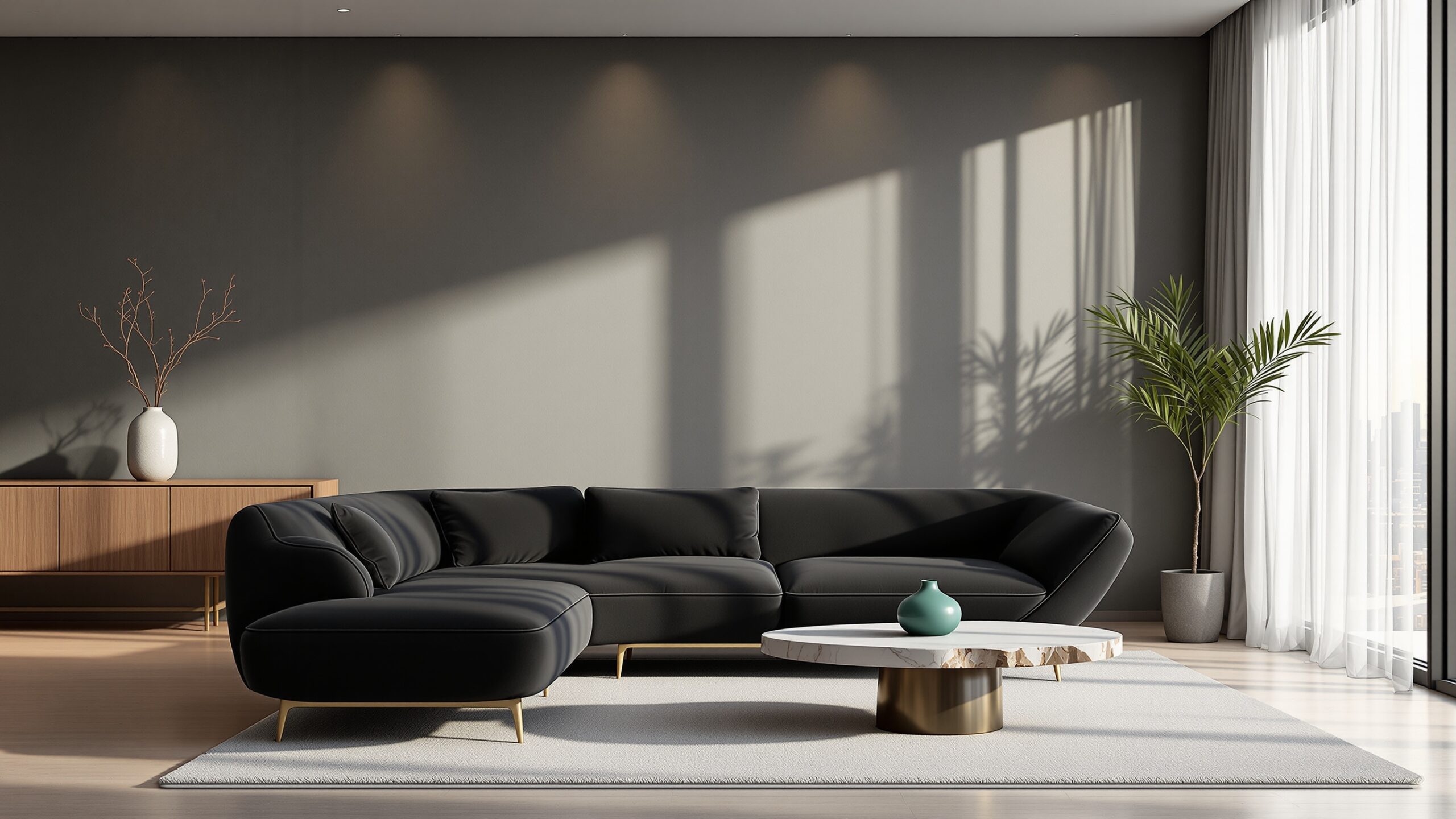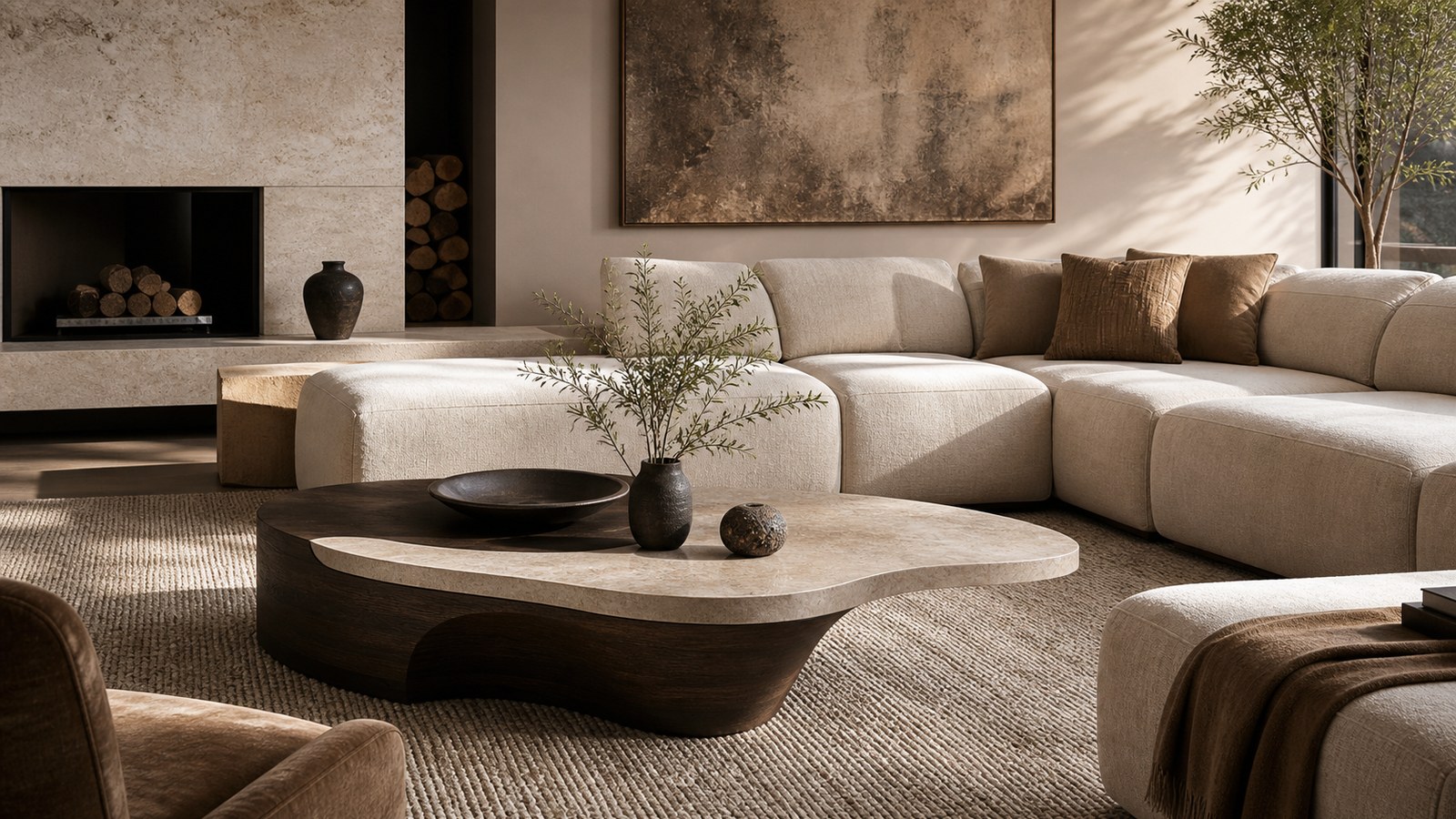
A coffee table may occupy fewer square feet than the sofa, yet it determines how the entire seating group looks and works. Its height controls reach, its silhouette changes circulation, its material sets a tactile note, and its surface becomes the room’s everyday stage. Luxury therefore begins with proportion and construction rather than a famous label or dramatic finish. This guide follows the decision from measured seating plan to delivery, styling, and maintenance, showing how one carefully chosen table can establish a stronger center while making conversation, serving, storage, and movement feel noticeably easier.
A: Round, oval, square, or oversized rectangular tables usually work best depending on the sectional layout.
A: They need coasters, gentle cleaners, and quick spill cleanup, but they can be very durable with care.
A: Marble, travertine, burl wood, glass, brass, and sculptural designs often create a luxury effect.
A: It does not need to match exactly, but the materials or tones should feel connected.
A: Use a tray, books, a candle, greenery, and one sculptural object while leaving open space.
A: Yes, glass keeps the room feeling open and visually lighter.
A: Rounded edges, sturdy bases, durable wood, and forgiving finishes are usually the safest choices.
A: Yes, a standout coffee table can elevate simple sofas, rugs, and chairs.
A: Aim for about two-thirds the sofa length and enough clearance for walking.
A: Add a beautiful tray, stacked design books, fresh florals, and one statement decorative piece.
Start With the Seating Plan, Not the Table
A coffee table is the physical center of a conversation group, so its dimensions should emerge from the sofa and chairs. Draw the seating footprint, mark circulation, and identify who needs a surface within reach. A beautiful table that forces guests to lean, blocks knees, or leaves a narrow passage will make the entire room feel less luxurious.
Aim for a balanced gap around the table rather than one rigid rule. Eighteen inches often works, but deep sofas, recliners, and compact rooms may need adjustment. Tape the footprint on the rug and live with it for a day. Walk through carrying a tray, extend a foot from every seat, and make sure drawers or doors can open.
Test this decision from the doorway and every main seat. Confirm that it improves circulation, cleaning access, glare control, and relationships among the sofa, rug, windows, and adjoining rooms. Keep it only when craft, proportion, comfort, and daily usefulness remain equally convincing.
Set Height for Comfort and Visual Rhythm
Most coffee tables work near the sofa seat height or slightly below it. A table far higher can feel like a dining surface; one dramatically lower may look elegant but perform poorly for drinks and books. Measure the compressed seat height while someone is sitting, because plush cushions settle more than showroom dimensions suggest.
Use nearby chair arms and side tables to create a varied but coherent horizontal landscape. A low sculptural table can be paired with accessible side tables for function, while a taller table may suit upright seating. Do not sacrifice ergonomics to a photograph. The most refined room allows people to use its center without thinking about it.
Test this decision from the doorway and every main seat. Confirm that it improves circulation, cleaning access, glare control, and relationships among the sofa, rug, windows, and adjoining rooms. Keep it only when craft, proportion, comfort, and daily usefulness remain equally convincing.
Choose a Silhouette That Corrects the Room
Shape can solve spatial tension. A round or oval table softens a boxy sectional and improves movement through tight corners. A long rectangle reinforces a linear sofa, while a square table can organize an equal-sided seating group. Organic shapes introduce movement, but their usable surface and reach distances should be tested rather than assumed.
Look at the negative spaces between the table, sofa, and chairs. Those channels should feel intentional and navigable. In an asymmetrical room, two nesting or clustered tables can connect seats more effectively than one centered slab. Keep one dominant geometry and allow smaller curves or angles to act as counterpoints.
Test this decision from the doorway and every main seat. Confirm that it improves circulation, cleaning access, glare control, and relationships among the sofa, rug, windows, and adjoining rooms. Keep it only when craft, proportion, comfort, and daily usefulness remain equally convincing.
Select Material by Touch, Weight, and Wear
Stone offers permanence and pattern, wood gives warmth and repairability, glass preserves sightlines, metal sharpens the outline, and lacquer brings concentrated color. Each material changes acoustics and maintenance as well as appearance. A travertine plinth feels grounded; a thin bronze frame with glass appears lighter; solid walnut can make a formal room more relaxed.
Ask for finish samples and use them. Set down a cold glass, drag a book gently, wipe a fingerprint, and view the surface in raking light. Polished marble can etch, unlacquered brass changes color, delicate veneer dislikes moisture, and clear glass shows dust. Luxury means choosing the aging process you can accept and maintain.
Test this decision from the doorway and every main seat. Confirm that it improves circulation, cleaning access, glare control, and relationships among the sofa, rug, windows, and adjoining rooms. Keep it only when craft, proportion, comfort, and daily usefulness remain equally convincing.
Understand Construction Beneath the Finish
A premium table should remain stable under normal leaning and resist racking when moved. Examine joinery, underside finishing, base attachment, stone reinforcement, glass thickness, and edge treatment. Large overhangs need engineering, and a heavy top requires a base that distributes weight without appearing clumsy. Ask how the table can be disassembled for delivery and future moves.
Open and close every drawer, swivel, lift-top, or nesting mechanism. Hardware should feel controlled and quiet, with no pinch points. Veneer should be intentionally matched across visible faces; stone seams and miters should align with the design. The unseen construction is what allows a dramatic silhouette to remain satisfying after the initial visual impact.
Test this decision from the doorway and every main seat. Confirm that it improves circulation, cleaning access, glare control, and relationships among the sofa, rug, windows, and adjoining rooms. Keep it only when craft, proportion, comfort, and daily usefulness remain equally convincing.
Use Scale to Reset the Room’s Hierarchy
An undersized coffee table makes substantial seating look disconnected and encourages a scatter of small stools. A properly scaled table gathers the arrangement and gives the rug a clear center. Conversely, an oversized block can turn the room into an obstacle course. Judge visual mass as well as dimensions: dark stone reads heavier than clear glass at the same size.
Photograph the taped footprint from the entrance and main seat. If the center feels empty, increase length or consider a pair. If the table consumes the rug and hides too much pattern, reduce mass through an open base or lighter material. The table should make the seating seem intentionally related, not merely arranged around an expensive object.
Test this decision from the doorway and every main seat. Confirm that it improves circulation, cleaning access, glare control, and relationships among the sofa, rug, windows, and adjoining rooms. Keep it only when craft, proportion, comfort, and daily usefulness remain equally convincing.
Plan Storage Without Creating a Visual Appliance
Drawers, shelves, and lift tops can support daily life when integrated into the form. Decide what must live at the center: remotes, coasters, games, chargers, or blankets. A shallow drawer may be enough and will preserve a cleaner silhouette than a bulky trunk. Open shelves work best when their contents are edited and easy to reach.
Check ventilation and cord routing for concealed charging, and avoid mechanisms that place hot drinks at risk when opened. Storage should not eliminate all clear surface or require moving decor before use. A table that hides clutter but feels cumbersome is not a true improvement. The best functional detail disappears until it is needed.
Test this decision from the doorway and every main seat. Confirm that it improves circulation, cleaning access, glare control, and relationships among the sofa, rug, windows, and adjoining rooms. Keep it only when craft, proportion, comfort, and daily usefulness remain equally convincing.
Commission a Piece for the Exact Conversation Group
Custom work is valuable when standard sizes leave awkward reach, the room needs a particular curve, or material continuity matters. Give the maker a measured plan, sofa heights, delivery path, preferred finish, and examples of use. Describe the mood and performance requirements instead of copying another designer’s table line for line.
Approve drawings that show dimensions, edge profiles, grain or slab direction, base construction, and finish. Ask for samples and clarify natural variation, lead time, payment stages, freight, assembly, and remedy for damage. A responsible commission balances the maker’s expertise with unambiguous practical expectations and leaves enough schedule for careful fabrication.
Test this decision from the doorway and every main seat. Confirm that it improves circulation, cleaning access, glare control, and relationships among the sofa, rug, windows, and adjoining rooms. Keep it only when craft, proportion, comfort, and daily usefulness remain equally convincing.
Style the Surface in Zones of Use
Divide the top mentally into open space, a contained composition, and a flexible landing area. A tray can gather coasters and a small object; a low stack of books adds height; a vessel or branch supplies an irregular line. Keep at least one generous area empty for drinks, a laptop, or a shared plate.
Vary height without building a centerpiece that blocks conversation. Use felt under ceramics and metal, avoid water-sensitive planters, and keep candles away from books and finishes vulnerable to heat. On richly figured stone or wood, fewer objects reveal more material. On clear glass, consider the view through the top and keep the shelf or rug below composed.
Test this decision from the doorway and every main seat. Confirm that it improves circulation, cleaning access, glare control, and relationships among the sofa, rug, windows, and adjoining rooms. Keep it only when craft, proportion, comfort, and daily usefulness remain equally convincing.
Pair the Table With the Rug and Lighting
The rug frames the table, while overhead and portable lighting determine whether its material reads beautifully. Leave enough rug visible to establish a border around the table. Strong geometric rug patterns usually favor a simpler table silhouette; a quiet rug can support a more expressive base or veined top.
Check reflections from windows, pendants, and downlights at seated eye level. A glossy top can mirror a bare bulb, while dark wood may disappear without nearby warm light. A floor lamp or shaded table lamp often reveals grain more gracefully than a harsh ceiling spot. Use dimming to keep the center present but not theatrical.
Test this decision from the doorway and every main seat. Confirm that it improves circulation, cleaning access, glare control, and relationships among the sofa, rug, windows, and adjoining rooms. Keep it only when craft, proportion, comfort, and daily usefulness remain equally convincing.
Make Delivery and Maintenance Part of the Purchase
Measure doors, elevators, stair turns, and the narrowest corridor before ordering. Record the packaged dimensions and weight, not just the assembled footprint. Heavy stone and glass deserve professional handling and floor protection. Confirm who carries, assembles, levels, removes packaging, and accepts responsibility if access differs from the information supplied.
Keep care instructions, finish names, touch-up materials, warranty details, and maker contacts. Use the correct cleaner, coasters, and protective pads from the first day. Tighten only hardware designed for owner adjustment. Knowing how a surface will patinate, whether it can be refinished, and how parts can be replaced is a more meaningful luxury than flawless newness.
Test this decision from the doorway and every main seat. Confirm that it improves circulation, cleaning access, glare control, and relationships among the sofa, rug, windows, and adjoining rooms. Keep it only when craft, proportion, comfort, and daily usefulness remain equally convincing.
Finish With Restraint and Let the Center Work
Once the table arrives, remove the temporary stools and decorative filler that compensated for the old layout. Reassess reach, walking paths, and the balance of the seating group. The new piece may make a side table redundant or reveal that a chair should turn slightly inward. Let it reorganize the room instead of forcing it into the previous arrangement.
Live with a mostly clear surface for a week before styling. Notice where people naturally place cups, books, and feet, then build a small composition around those habits. A transformative luxury coffee table does not demand attention every minute. It gives the room a stronger center, makes use easier, and rewards a closer look through proportion, material, and craft.
Test this decision from the doorway and every main seat. Confirm that it improves circulation, cleaning access, glare control, and relationships among the sofa, rug, windows, and adjoining rooms. Keep it only when craft, proportion, comfort, and daily usefulness remain equally convincing.